The Western Front
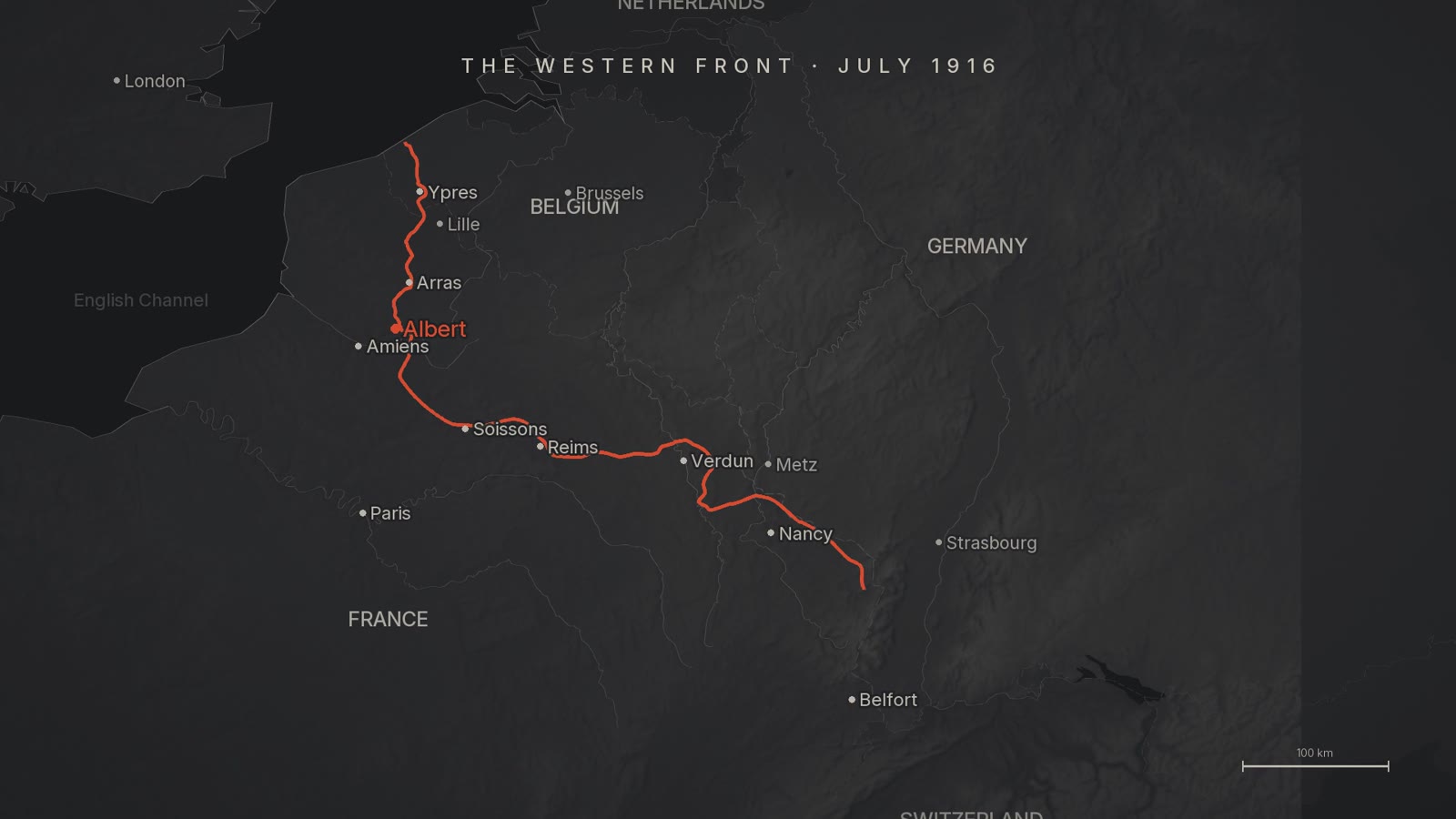
July 1916. A line of trenches from the Channel coast to Switzerland.
Our trace after the US Military Academy map of the Western Front, 1915–16. Natural Earth.
The Somme
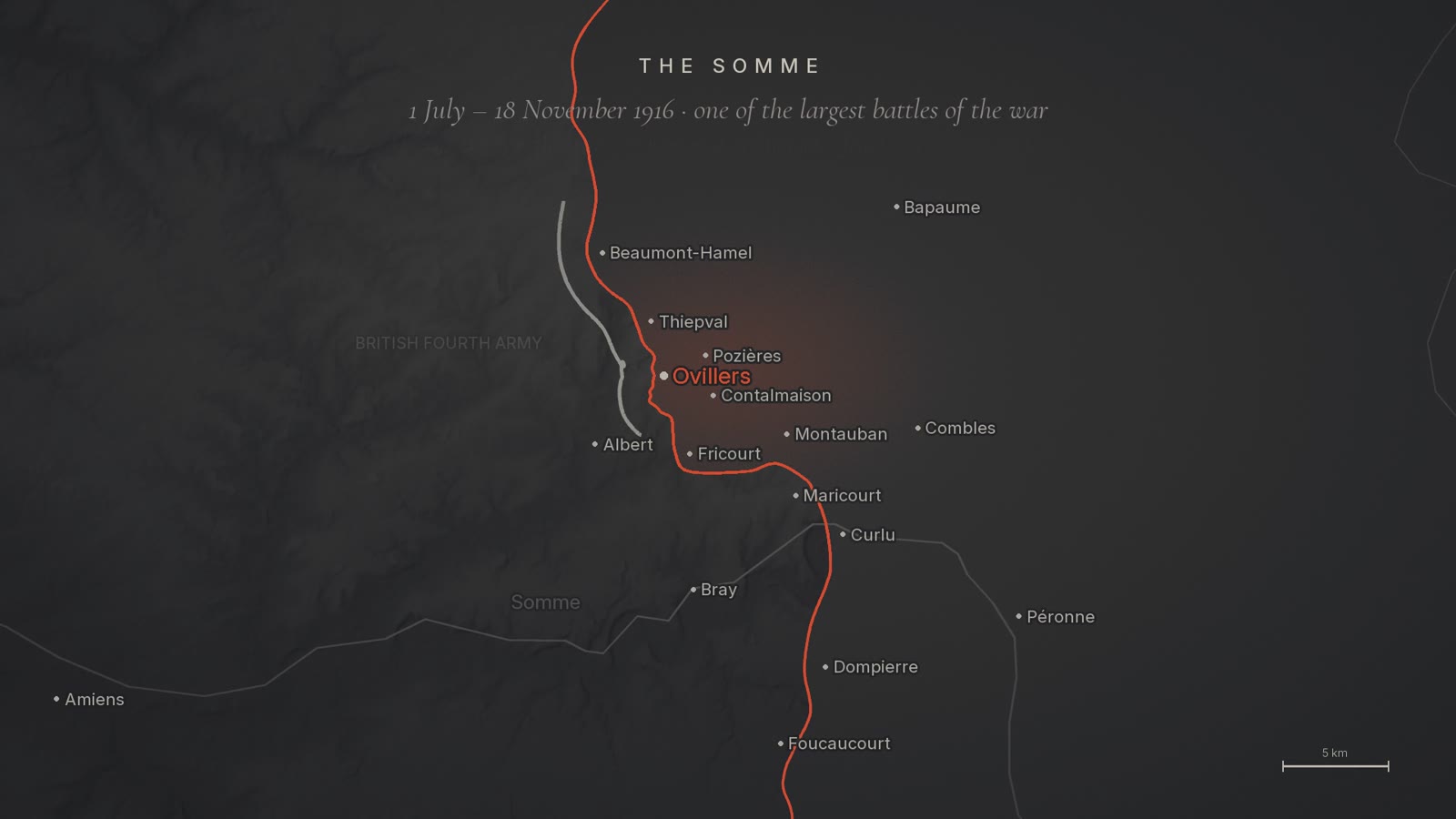
1 July 1916, the first day of one of the largest battles of the war.
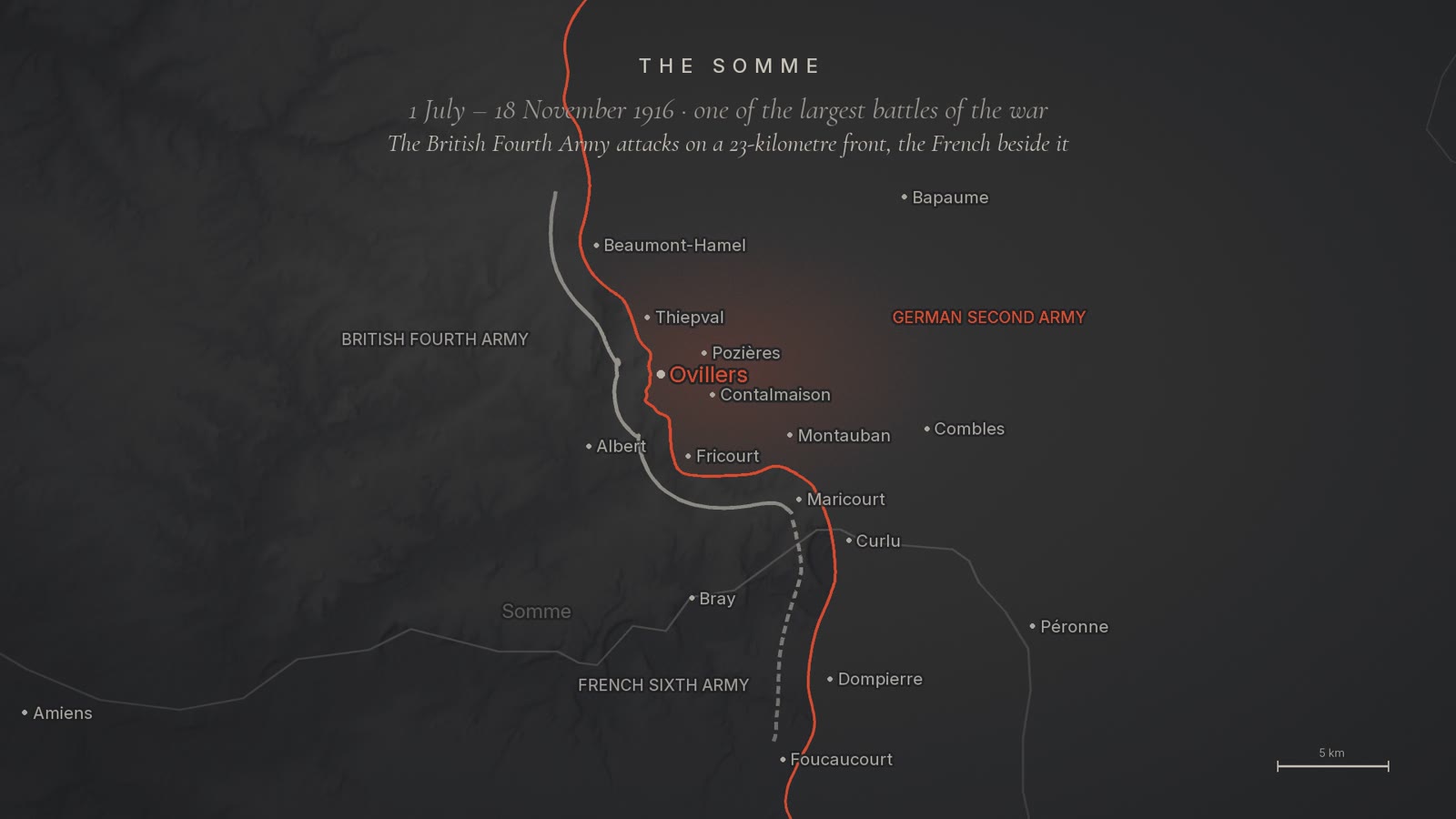
Two armies attack
The British Fourth Army on about 23 km north of the river, the French Sixth Army beside it. In the seven days before, the Fourth Army's guns fired 1,508,652 shells.
Edmonds 1932, vol. I: a front of 25,000 yards; daily totals, p. 302.
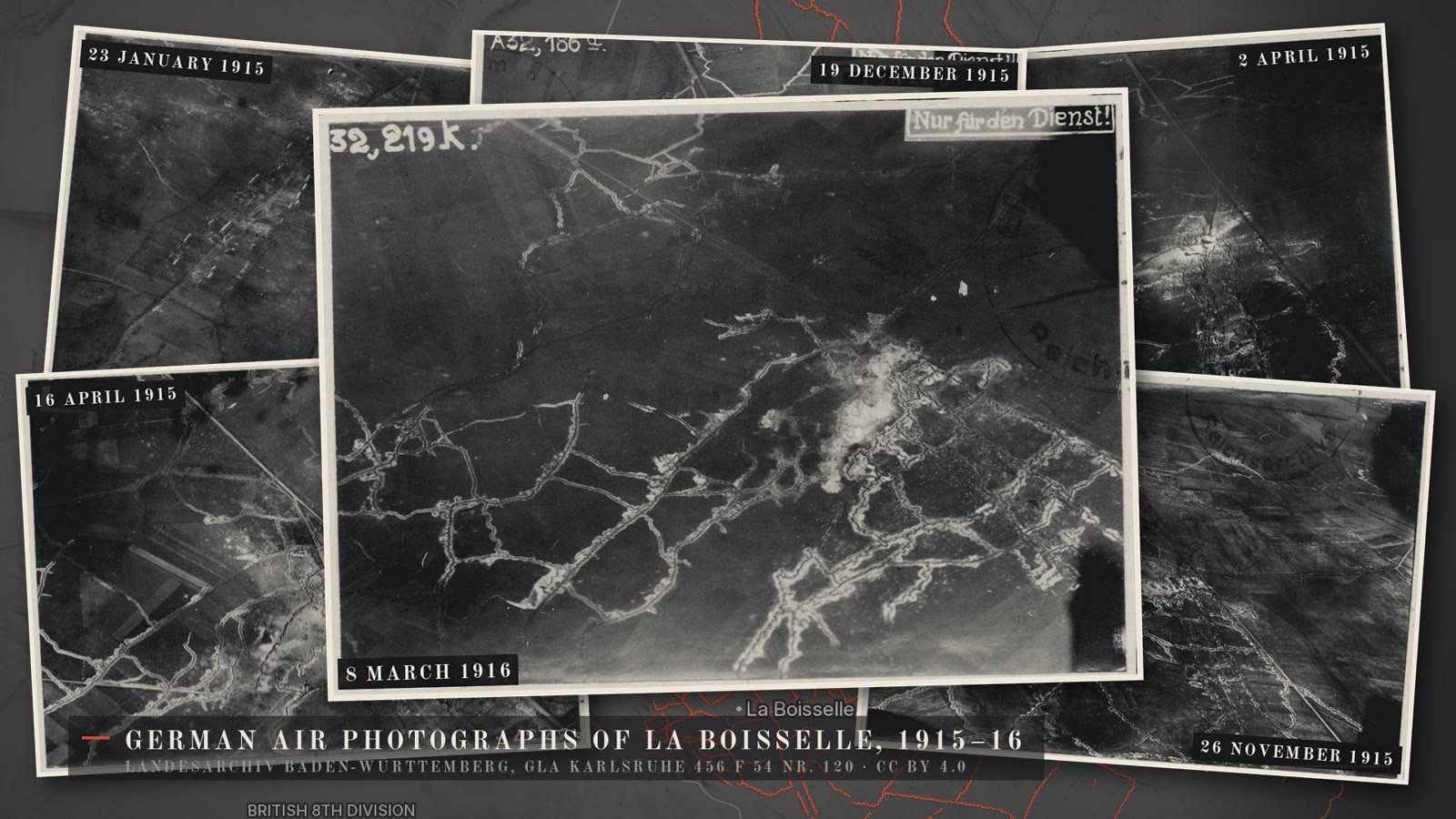
La Boisselle from the air
German air photographs, 1915–16. We checked our trenches against these and the British trench map.
Landesarchiv Baden-Württemberg, CC BY 4.0.
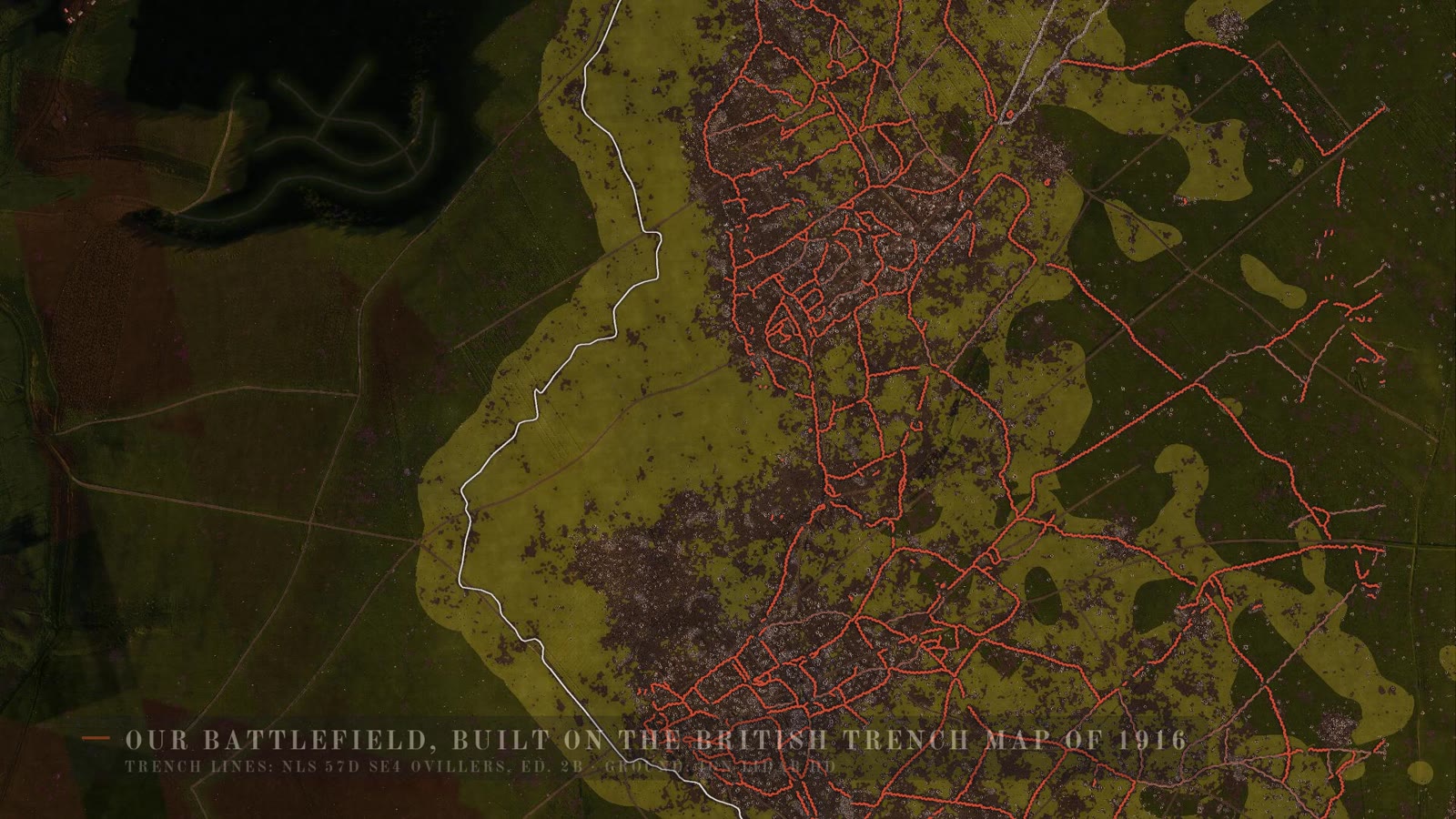
Our battlefield
The same trenches, built into 3D ground from the British trench map of 1916.
British trench map 57D SE4, Ed. 2B. National Library of Scotland, CC BY.
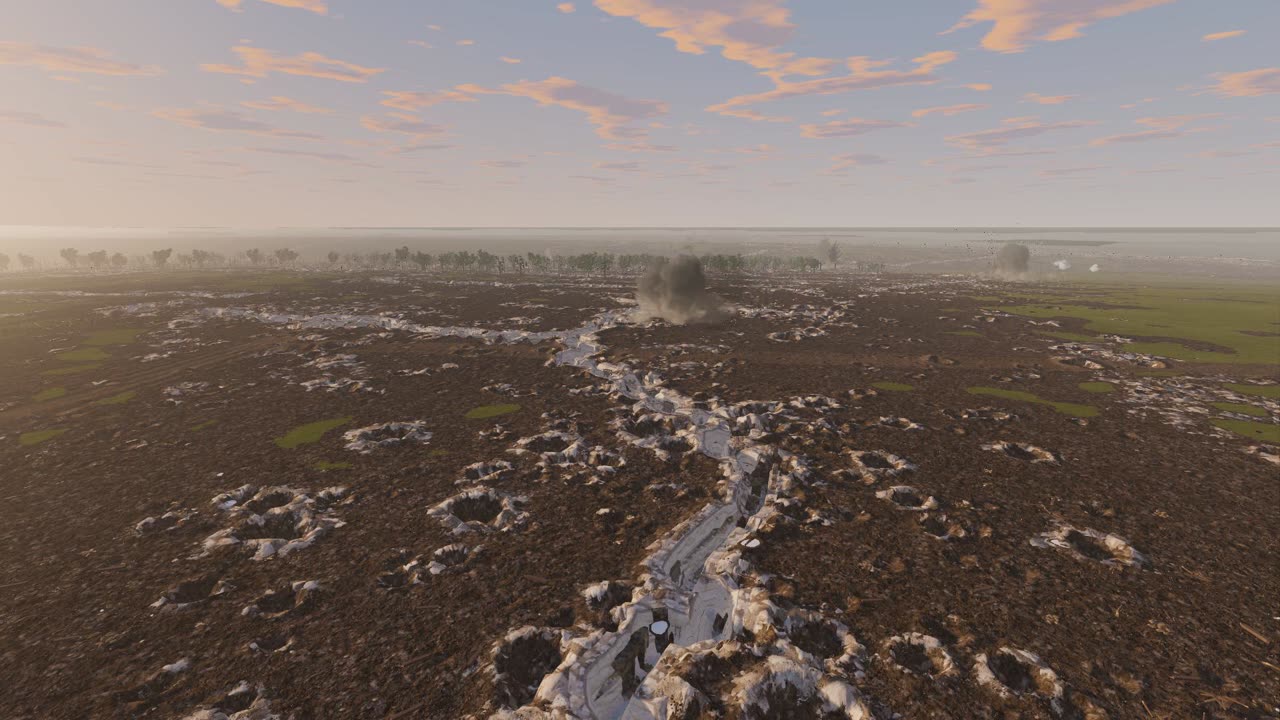
Ovillers, 07:19
Twenty-five metres above the German front trench, eleven minutes before the 8th Division attacked.
The 11-minute barrage
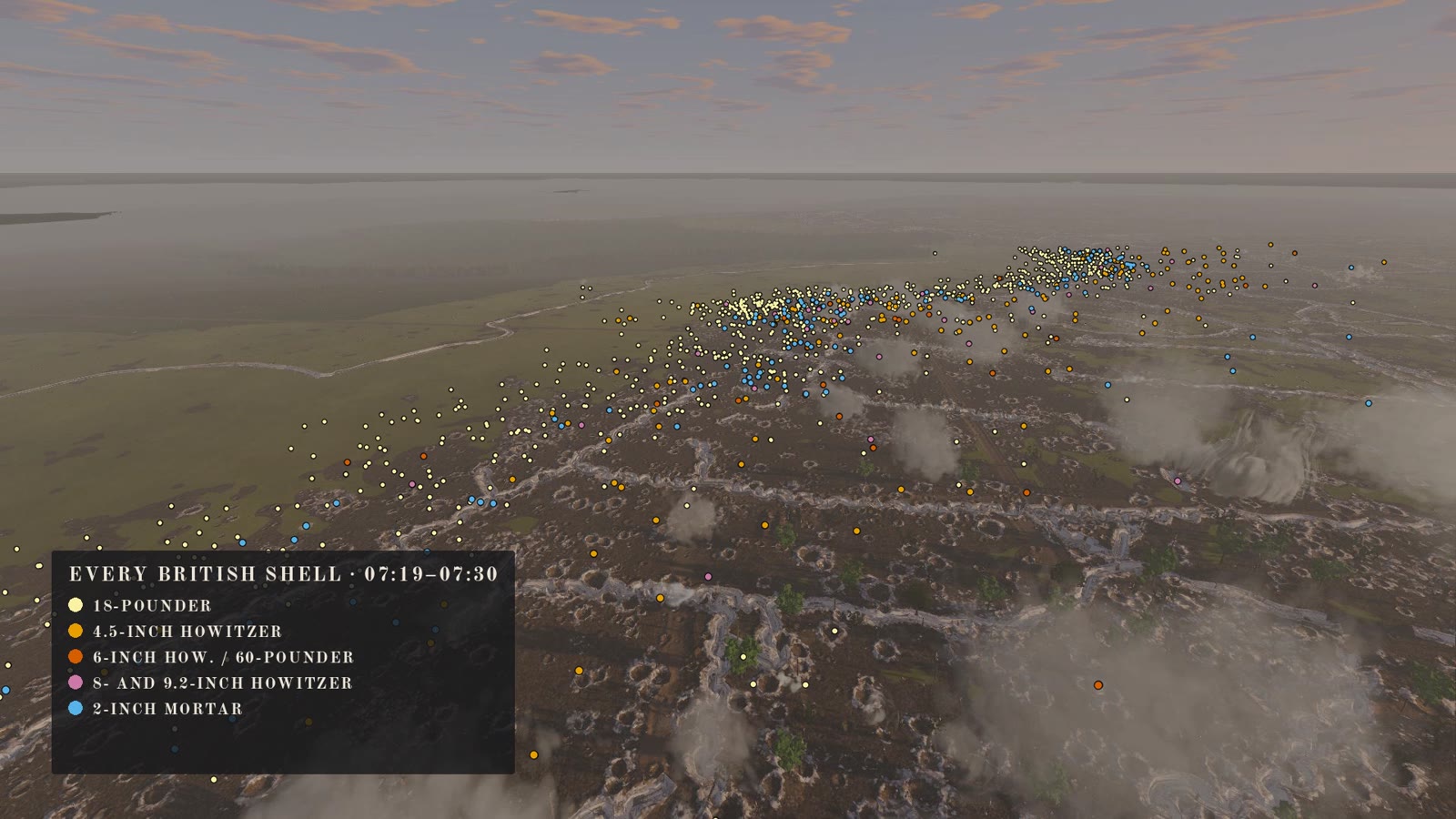
Each dot is one British shell in the simulation, from 07:19 to 07:30, on the 1.46 km of German line shown in the film. The film also has 41,627 more distant shells that you hear but that are not on this map.
How the count is made. Field guns and mortars fire at the rates in the 8th Division's orders; the share of heavy howitzers is our estimate. These are the simulation's shells, scheduled from those records. Base map: IGN LiDAR hillshade with the 1916 trenches from British map 57D SE4.
Explore the battlefield
The same eleven minutes from fifteen camera positions. Click a number on the map or step through the views. The time under each view is the moment it shows.
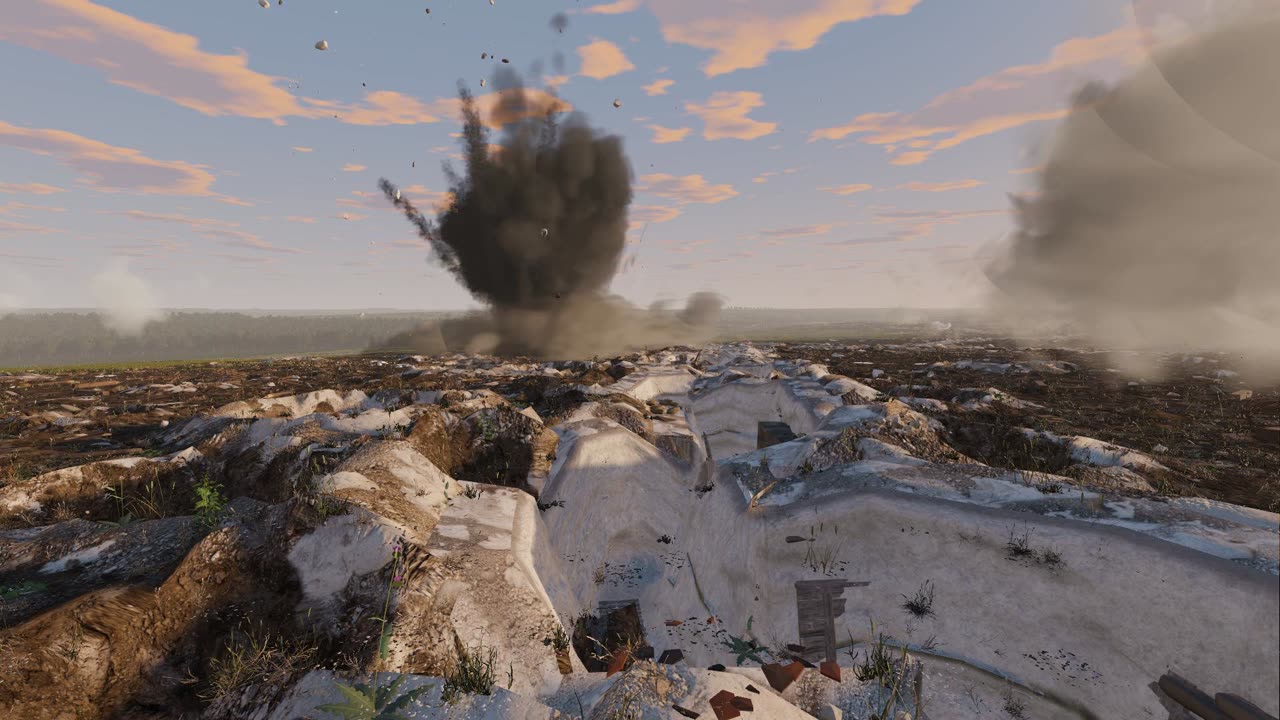
The guns and the fire table
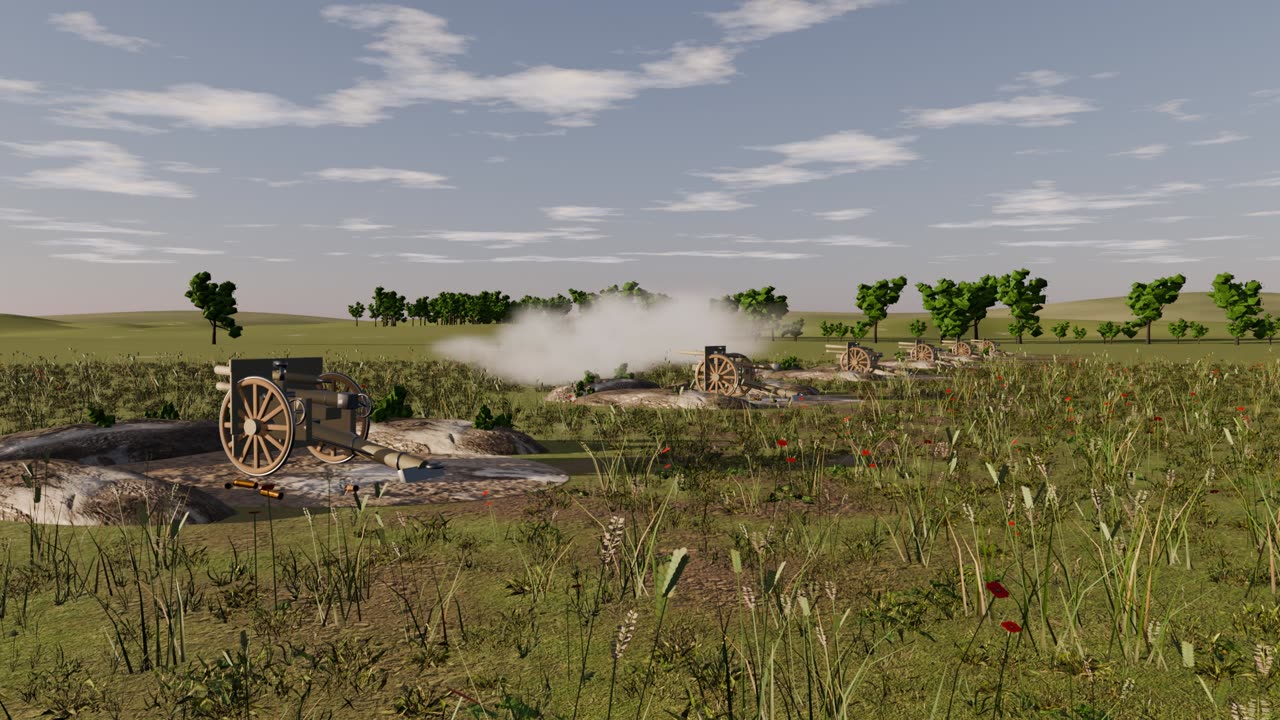
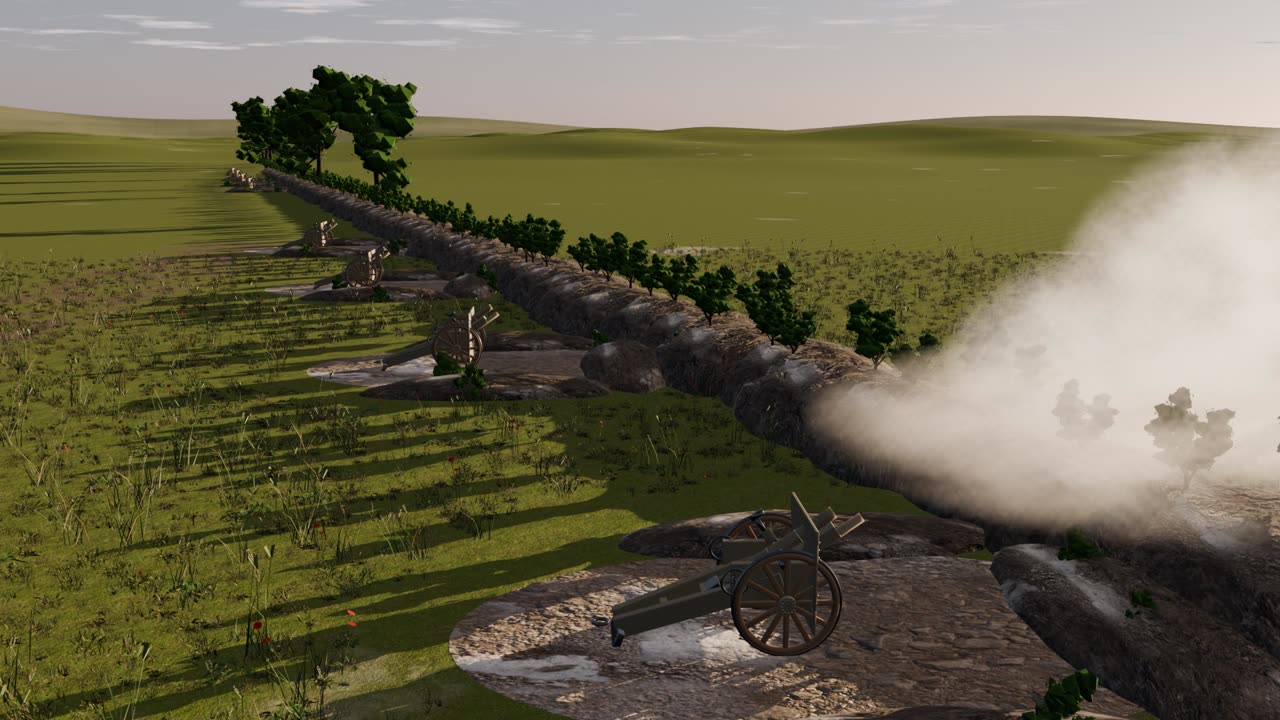
The 8th Division's own fire table sets the pace of the field guns. It is also the film's clock: the hurricane at 07:20, the mortars at 07:22, the lift at 07:30.
| TIME | CLOCK | 18-PDRS | 4.5" HOWS |
|---|---|---|---|
| -65 to -10 | 06:25–07:20 | ½ round per gun per minute | ½ round per how. per minute |
| -10 to 0 | 07:20–07:30 | 3 rounds per gun per minute | 1 round per how. per minute |
| 0.00 | 07:30 | lift to the BLUE line | lift, line to line |
Our typed transcription. Original in the war diary, The National Archives WO 95/1684.
| In the simulation | Guns | Shells drawn |
|---|---|---|
| Stokes 3-inch mortar | 24 | 2,157 |
| 18-pounder (HE and shrapnel) | 32 | 1,056 |
| 4.5-inch howitzer | 14 | 167 |
| 2-inch trench mortar | 28 | 142 |
| 6-inch howitzer | 4 | 23 |
| 8-inch howitzer | 6 | 23 |
| 9.2-inch howitzer | 4 | 12 |
| 9.45-inch trench mortar | 6 | 10 |
| Total | 3,590 |
Rows in italics are our estimates: the records name the heavy batteries but not their guns or rates, and the number of 9.45-inch mortars is undocumented. Stokes count and rate: Edmonds 1932, pp. 385–386. Field guns and howitzers: the fire table. Counts are for the 1.46 km in the film.
The historical records
The simulation is built from these orders, maps, photographs and books. Where the records stop, we estimate and say so. Open any item to see what it is and how we used it.
Modern recordings of real guns and explosions
The closest matches we could find, from recent wars and live-fire ranges. Every clip is catalogued with its source, licence and what it is.
Licences: BBC RemArc (personal, educational) · rights not yet established · public domain (DVIDS) · CC BY / CC0 · CC BY-NC · editorial / restricted.
- BBC Sound Effects archive
- Freesound
- DVIDS (US military media)
- Maximilian Clarke
- Puolustusvoimat – The Finnish Defence Forces
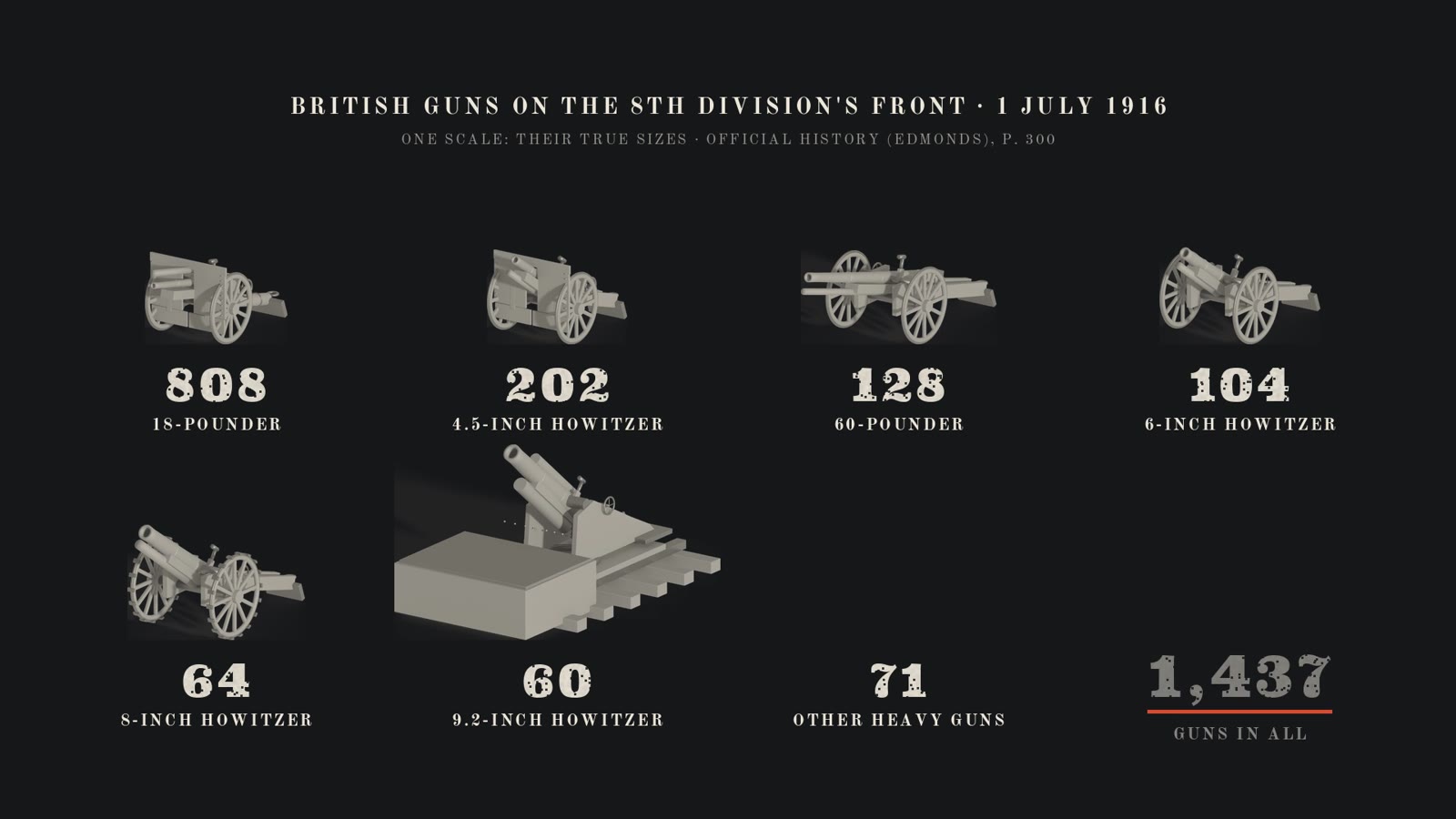
- Edmonds, Military Operations France and Belgium 1916, vol. I (1932)Guns on the front (p. 300), the seven days' shell totals (p. 302), Stokes mortars (pp. 385–386)
- 8th Division Artillery orders and fire table, 22–23 June 1916Field-gun and howitzer rates; The National Archives WO 95/1684
- Ernst Jünger, The Storm of Steel, tr. Basil Creighton (1929), p. 81Quoted in the film
- Philipp Witkop (ed.), German Students' War Letters (1929), p. 322Quoted in the film
- Natural Earth, Wikidata, Copernicus DEM (© DLR, Airbus), IGN LiDAR HDMaps and terrain